Solid carbide end mills
From roughing structural steel to a finishing pass over hardened material, from graphite to heat-resistant alloys. Nine series by application and nine coatings for different cutting conditions.
We reply within the working day. There is no minimum order.
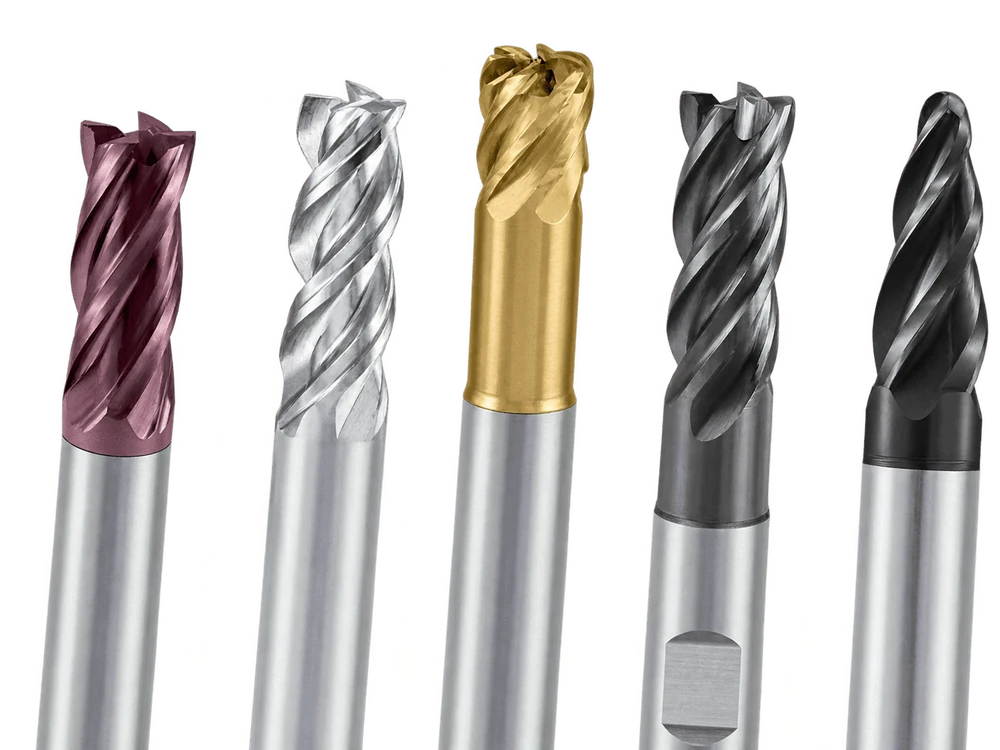
Model range
We do not offer one end mill “for everything” — there is no such thing. Instead, every class of material and every type of operation has its own series with its own geometry and coating.
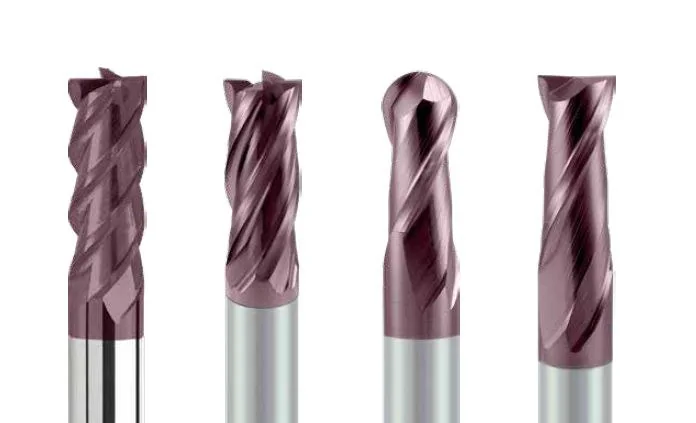
The workhorse of any shop: contours, slots and pockets in structural steel and cast iron. A rigid body design and a stable size right through the batch.
Two versions: a basic one for general milling and a high-performance one for when you have to remove more in the same cycle time.
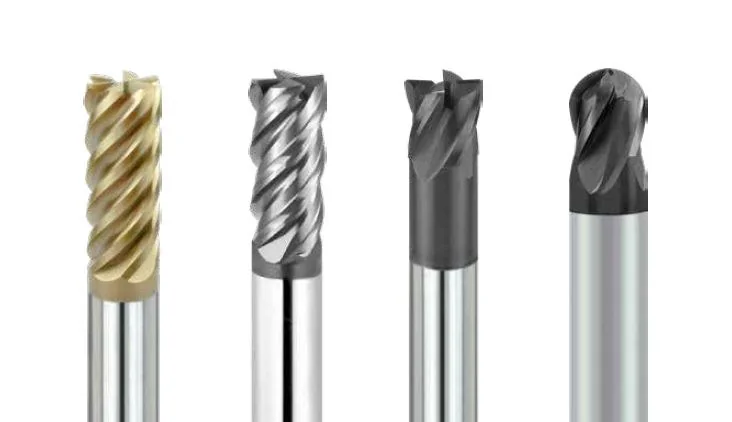
Machining hard material without tempering the part first. Several versions for different hardness levels — from 35 HRC to 70 HRC — and for different jobs: general milling, high-speed cutting, high-accuracy finishing.
For finishing operations — ball nose end mills with a radius tolerance within a few microns. The multi-flute version with a high helix angle is for side milling, the low-helix one for face milling.
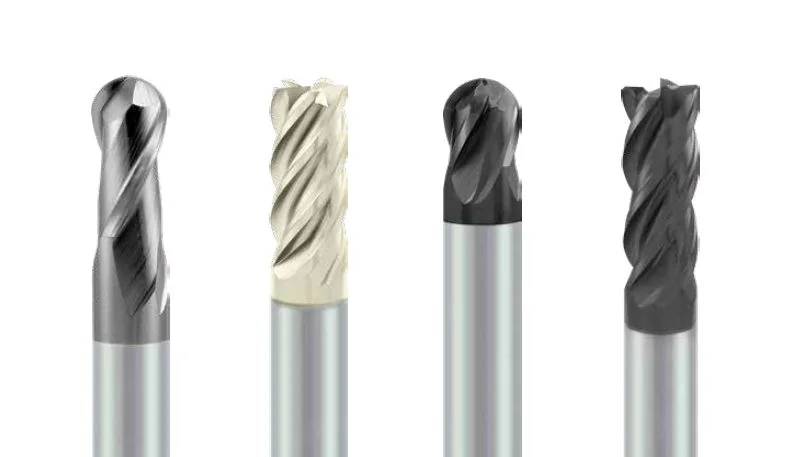
A material that stretches instead of cutting and takes the edge off quickly. This is where an unequal tooth pitch works: the tool does not fall into resonance and the vibration never has time to build.
The programme includes both a high-performance version for heavy stock removal and a rigid one — for unstable clamping and thin walls.
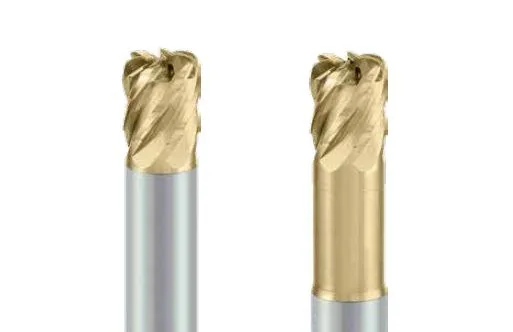
A strategy in which you take a small depth of cut but at a very high feed. The metal comes off by volume and the load is directed along the spindle axis — the machine takes what would have shaken it in conventional milling.
There is a version with a central internal coolant channel — the chip does not stay in the cutting zone in a deep pocket.
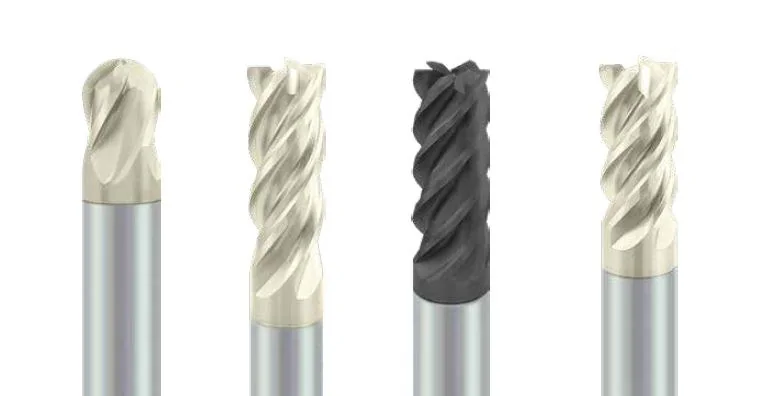
Inconel, titanium, alloys for turbine parts — materials that forgive neither excessive speed nor vibration. A variable tooth pitch together with a variable helix angle damps oscillation in two planes at once.
Designed for high-efficiency removal: what is usually done slowly on these materials is done faster here — without losing the edge.
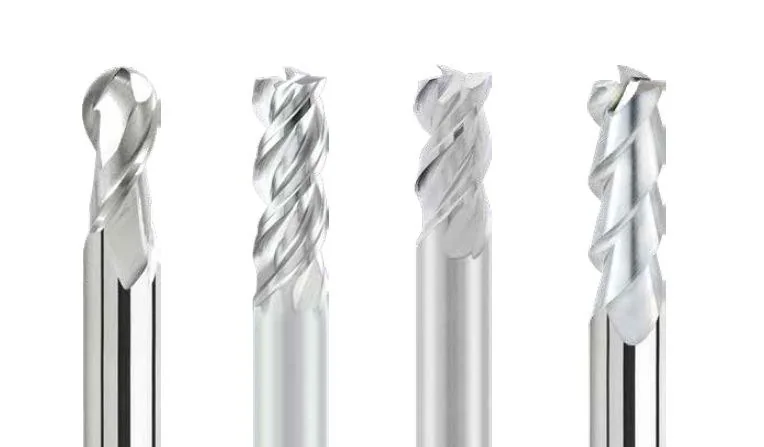
For aluminium and copper — high-speed cutting, a polished flute and excellent chip release: the metal does not stick and the surface comes out mirror-like with no further work.
For graphite — a separate version with a thick diamond coating: abrasive dust wears out ordinary tooling in hours.
For CFRP, GFRP and Kevlar — a series designed against fibre delamination where the edge exits.
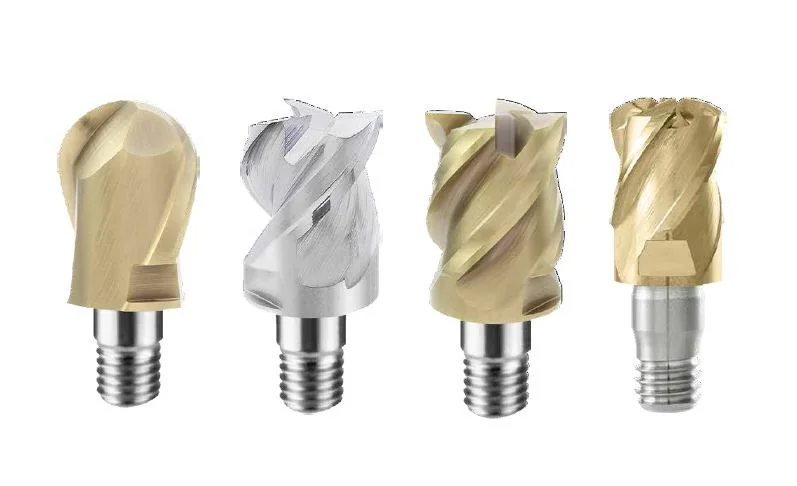
An exchangeable carbide head on an adapter — with no brazed joint. Only the cutting portion is consumed, not the whole tool: carbide consumption falls several times over compared with a solid end mill of the same diameter.
One tool gives you several overhangs: adapters of different lengths — for ordinary work and for deep work. The steel adapter is economical, the carbide one holds its rigidity where a steel one already starts to flex.
Head versions: square, corner radius, ball nose, chamfer.
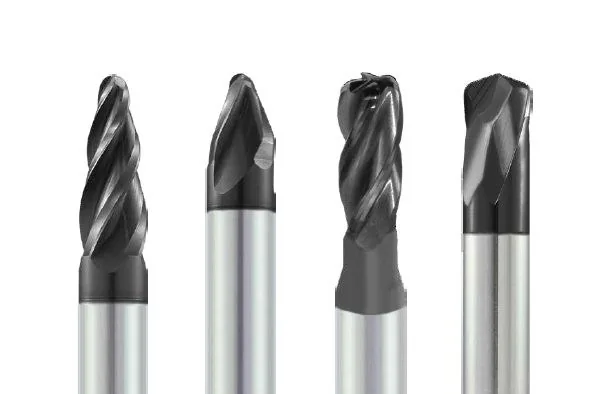
Tooling for 5-axis machines. Thanks to the large form radius, the contact line with the part is far longer than with a ball nose cutter — a greater depth of cut per pass, fewer stepovers, and finishing time cut several times over.
The surface comes out smoother and tool life is longer. Moulds and dies, aerospace parts, turbine blades and impellers.
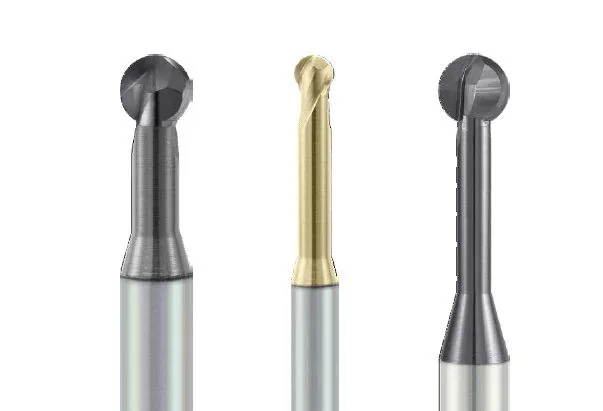
A sphere on a slim neck with a wrap angle of 220°, 260° or 300°. It reaches where an ordinary end mill cannot: undercuts, back faces, internal radii.
Its second job is deburring after milling, particularly on vertical walls, where hand finishing always leaves a mark.
Coating
The coating decides how long an end mill will live. The same geometry with a different coating gives a different tool life on the same material — sometimes double.
That is why KARASAWA does not have one “house” coating for the whole catalogue but nine: seven PVD coatings for different classes of steel and alloy, and two CVD diamond coatings for abrasive materials. The coating is selected together with the series — you get the right pairing to begin with.
| Coating | Colour | Type | Composition | P | M | K | N | S | H | Where this works |
|---|---|---|---|---|---|---|---|---|---|---|
| ECObasic | PVD | TiAlN | ● | ○ | ● | — | — | ○ | Everyday milling of steel and cast iron. When the job is ordinary and the tooling budget is being counted. | |
| ECO-Xsmooth | PVD | TiAlN | ● | ● | ● | — | ○ | ○ | The same, but with a smooth coating surface: the chip slides off more easily and sticks less. A universal choice for a mixed range of work. | |
| STRONG-Xsmooth | PVD | AlTiN | ● | ● | ● | — | — | ○ | Higher heat resistance. For when the cutting speed goes up and coolant delivery into the zone is limited. | |
| STRONGsmooth | PVD | AlTiCrN | ● | ● | ● | — | ● | ○ | The chromium in it holds off oxidation. Stainless, heat-resistant alloys, long passes with a high temperature in the cutting zone. | |
| MEGAsmooth | PVD | AlTiSiN | ● | ● | ● | — | ● | ● | The widest range in the line — the only coating that covers both heat-resistant alloys and hardened steel. The silicon in it raises the hardness of the layer sharply. | |
| MEGA-Ssmooth | PVD | AlTiXN+ZrN | ○ | ● | ○ | — | ● | — | Specialised for stainless and heat-resistant alloys. The zirconium layer works against ductile material sticking to the edge. | |
| NACOnanocomposite | PVD | Nano AlTiSiN | ● | ○ | ● | — | ○ | ● | A nanostructured layer for the hardest materials. Where an ordinary coating burns off in a few minutes. | |
| DIAMONDdiamond | CVD | Diamond | — | — | — | ● | — | — | A thick diamond layer. Graphite, ceramics, composites — abrasives that wear off any PVD coating in a single shift. | |
| DIAMOND-Xdiamond-like | CVD | Diamond-like | — | — | — | ● | — | — | Very low friction. Aluminium, copper, plastics — where the main problem is not wear but metal sticking to the edge. |
A small thing that saves time at the tool crib: every coating has its own colour. Violet is the basic series, dark is heat-resistant, gold is the universal MEGA, blue is for hardened materials, black is diamond. The storekeeper tells the series apart at a glance, without checking the delivery note.
In summary
Nine series and nine coatings is not about the length of the catalogue. It is about three specific things.
Steel, stainless, aluminium, hardened material, graphite, 5-axis work — all on one price list and one delivery note. Fewer invoices, fewer phone calls, fewer people to chase.
The series and the coating are chosen together. You do not have to decide which of the nine coatings to specify — you get a ready combination for your material.
Common items are held in stock. The most expensive end mill is not the one that costs a lot but the one that is not there when the machine is already standing.